
- Home
- Upgrade Planning
- Payback Period Calculator
Payback Period Calculator
Enter an upgrade cost plus both net hourly rates to see how long the extra earnings take to repay your purchase.
How it works, step by step
- Enter the one-time cost of the upgrade you are evaluating.
- Use the net hourly earnings of your current setup as the baseline.
- Enter a trial rate or a rate you want to test for the upgraded setup.
- Compare the payback time with how long you expect to use the upgrade.
Examples with real results
| Input | You get |
|---|---|
| Recovering a 3,000-coin purchase Upgrade cost: 3000 coins · Current net hourly earnings: 1600 coins/h · Upgraded net hourly earnings: 2200 coins/h | Estimated payback time: 5 h Change in hourly earnings: 600 coins/h |
| A paid upgrade earns the same Upgrade cost: 1800 coins · Current net hourly earnings: 1500 coins/h · Upgraded net hourly earnings: 1500 coins/h | Estimated payback time: Change in hourly earnings: 0 coins/h |
| No purchase price Upgrade cost: 0 coins · Current net hourly earnings: 1200 coins/h · Upgraded net hourly earnings: 1100 coins/h | Estimated payback time: 0 h Change in hourly earnings: -100 coins/h |
The method behind it
Subtract the current net hourly rate from the upgraded net hourly rate. The difference is the hourly benefit attributable to the upgrade under the entered assumptions.
For a positive benefit, simple payback equals the one-time cost divided by extra net coins per hour. The division returns hours.
A paid upgrade has no finite payback at an unchanged or lower rate. An upgrade with no cost has zero hours of cost to recover.
Cost, sign-up and privacy
- Cost
- Free forever at $0, with unlimited uses and no daily limit.
- Account
- No login and no sign-up.
- Privacy
- Your input stays in your browser and we do not store it.
- Branding
- Nothing is stamped on your output: no watermark and no logo.
- Output
- Copy the answer as plain text (TXT), or copy a link that keeps your inputs.
When would a fishing upgrade pay for itself?
The free payback period calculator compares an upgrade with the setup you could keep using. If the new setup earns 2,000 coins an hour and the old one earns 1,500, only the extra 500 counts toward recovering the purchase. A price of 2,500 coins takes five hours to recover at that difference. Using the entire 2,000-coin rate would assign earnings to the upgrade that you could have made anyway.
Measure both setups on the same terms
Use the same rules for bait, travel, and selling when timing each run. For example, compare two rates that both include travel from the same starting point. If your current route earns 1,800 net coins per hour and the upgraded setup earns 2,100, the hourly gain is 300. If a longer trip to the upgraded spot reduces that figure to 1,950, the gain is only 150. That doubles the estimated time to recover the same purchase.
Work backward from the time you will use it
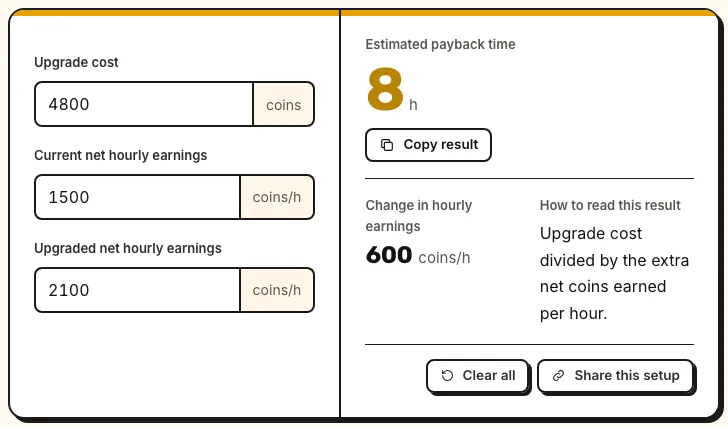
If a rod costs 4,800 coins and you expect to use it for eight hours before switching setups again, it would need to add 600 net coins per hour to pay for itself in that window. Use this comparison to set a target for a trial run. An estimate based on more than one session is easier to interpret when one catch accounts for much of the upgraded setup’s earnings. To estimate how long it takes to collect the purchase price in the first place, use the Savings Goal Calculator.
Where do the default rates come from?
The 3,000-coin price, 1,600 baseline and 2,200 trial rate are a practice scenario from the rod selection guide. The update needs to earn an extra 600 coins per hour to repay the price in five hours. Use the four-trip payback example to compare rates from a set of sample runs instead. The run log shows how to reproduce the two rates, and how a large isolated sale can move the estimate from under three hours to over eighteen. Keep your actual run totals and the purchase price together so you can revisit the result after more trips.
Things to keep in mind
- The estimate assumes the difference in rates persists over the measured hours.
- The calculation values coin earnings alone and omits resale proceeds and benefits that do not earn coins.
Questions people ask
How does the payback period calculator work?
It divides the upgrade cost by the increase in net coins per hour. A cost of 3,000 coins and a gain of 600 coins per hour imply five hours.
What happens when the upgraded setup earns less?
A paid upgrade has no payback at a lower net rate. The hourly change shows how much less it earns.
Do I include the purchase in the upgraded hourly rate?
Put the one-time price in the cost field. Keep the hourly rate for repeatable costs, such as bait you use while fishing.
Can payback time tell me if I can afford a rod?
Payback estimates how long extra earnings take to recover the price after purchase. The savings goal tool estimates time to afford the purchase.
Is the payback period measured in days or hours?
It is measured in hours spent earning at the entered rates. A five-hour payback takes five play sessions if you fish one hour per session.
Can I use a negative net rate?
Yes. A loss that falls from 300 to 100 coins per hour has a 200-coin hourly benefit, even though both setups still lose coins.
Reviewed Built and tested by Secret Animals Guide team