
- Home
- Fishing Tools
- Fishing Session Calculator
Fishing Session Calculator
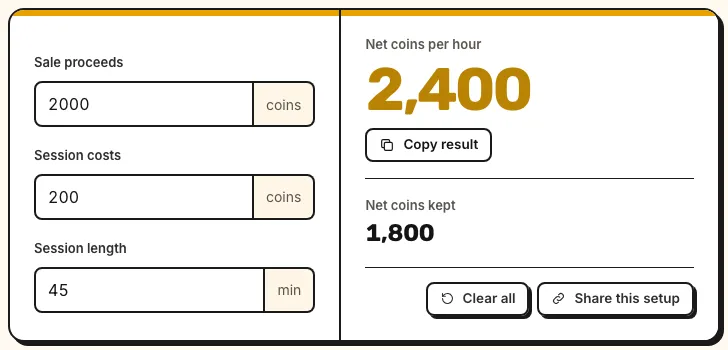
Enter your sales, costs, and time to see the net coins you kept and compare your fishing runs by the hour.
How it works, step by step
- Record the proceeds from selling catches made during your timed run.
- Add the costs you want counted, such as bait used during the run.
- Enter elapsed minutes and compare the net total with the hourly pace.
Examples with real results
| Input | You get |
|---|---|
| Twenty minutes with bait costs Sale proceeds: 1200 coins · Session costs: 200 coins · Session length: 20 min | Net coins per hour: 3,000 Net coins kept: 1,000 |
| Break-even trip Sale proceeds: 250 coins · Session costs: 250 coins · Session length: 15 min | Net coins per hour: 0 Net coins kept: 0 |
| Short session with no sales Sale proceeds: 0 coins · Session costs: 40 coins · Session length: 10 min | Net coins per hour: -240 Net coins kept: -40 |
The method behind it
Net coins equal your sale proceeds minus your session costs.
Divide net coins by elapsed minutes and multiply by 60 minutes per hour to express the measured pace per hour. The calculation uses arithmetic and the standard conversion from minutes to hours.
Cost, sign-up and privacy
- Cost
- Free forever at $0, with unlimited uses and no daily limit.
- Account
- No login and no sign-up.
- Privacy
- Your input stays in your browser and we do not store it.
- Branding
- Nothing is stamped on your output: no watermark and no logo.
- Output
- Copy the answer as plain text (TXT), or copy a link that keeps your inputs.
Compare your own fishing runs
Pick two sessions that answer a specific question, such as whether a different area earns more coins once you count travel and bait. Start your timer at the same point in each run and write down actual sale proceeds. If you sold items you caught in an earlier session, separate those proceeds before entering the total.
For example, 1,200 coins in sales and 200 in bait costs leave 1,000 coins over 20 minutes, which is a 3,000-coin hourly pace. A much shorter run with one unusually valuable catch can produce a higher figure. Record several runs and divide their combined net earnings by their combined duration to see how the setups compare over more playing time.
Compare a ten-minute run with a fifty-minute run
A ten-minute run that nets 700 coins comes out to 4,200 coins per hour. A fifty-minute run that nets 1,500 coins comes out to 1,800 coins per hour. To summarize both runs, enter the combined sale proceeds, combined costs, and 60 total minutes. The result is 2,200 coins per hour across the full hour played. Averaging the two separate rates gives 3,000 and gives the short run too much weight. Use the Weighted Average Calculator when your notes contain the hourly rates and elapsed minutes for each run rather than the separate sale totals.
Keep upgrade costs consistent
If you buy a rod during a session, save its price alongside your run notes. Include it in costs when checking the immediate change to your coin balance. For a repeatable earnings comparison, enter only the costs that recur each run and compare the rod price separately. Set a cost to zero explicitly when you had no expense. A zero-sales run with 40 coins in costs and 10 minutes of play returns −40 net coins and −240 net coins per hour.
Things to keep in mind
- An hourly pace extrapolates one recorded session and cannot predict future catches.
- Unsold catches are excluded until their sale proceeds are known.
Questions people ask
How does the fishing session calculator work?
Enter sale proceeds, session costs, and elapsed minutes. It calculates net coins and scales that measured result to one hour.
Should I include the cost of bait?
Include bait used during the run when comparing net earnings. Apply the same accounting rule to every run you compare.
Should I count my rod purchase?
Count it if you want the total impact of that purchase on this run. Leave it out when comparing the repeatable pace of two existing setups.
What if I earned fewer coins than I spent?
The tool displays a negative net result. That shows how much the session cost you after sale proceeds.
Do I include travel and selling time?
Include both for an end-to-end rate. For a casting-only comparison, track the same shorter time window for both setups.
Does the tool use official fish prices?
It uses the sale proceeds you enter from your run. Prices and catches do not need to be looked up for the calculation.
Reviewed Built and tested by Secret Animals Guide team