
- Home
- Fishing Tools
- Drop Chance Calculator
Drop Chance Calculator
Enter a drop rate and number of attempts to see your chance of at least one drop or no drops.
How it works, step by step
- Enter the chance for one eligible attempt as a percentage.
- Enter how many attempts you want to model under the same conditions.
- Read the chance of at least one drop alongside the chance of none.
Examples with real results
| Input | You get |
|---|---|
| One percent across 100 attempts Drop chance per attempt: 1 % · Independent attempts: 100 | Chance of at least one drop: 63.396766 % Chance of no drops: 36.603234 % |
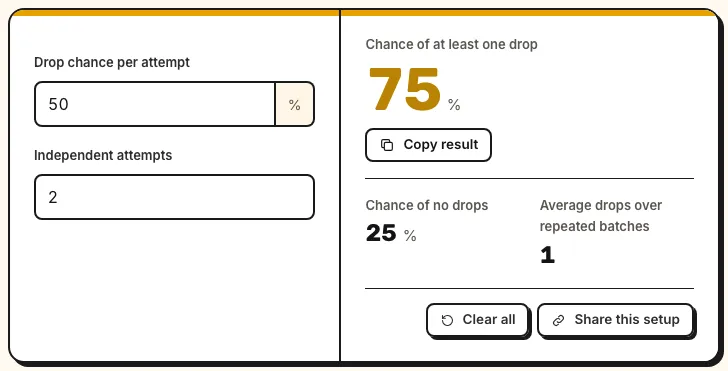
| Even odds on two attempts Drop chance per attempt: 50 % · Independent attempts: 2 | Chance of at least one drop: 75 % Chance of no drops: 25 % |
| Guaranteed rate with zero attempts Drop chance per attempt: 100 % · Independent attempts: 0 | Chance of at least one drop: 0 % Chance of no drops: 100 % |
The method behind it
The complement rule gives a one-attempt miss probability of 1 minus p, where p is the entered rate divided by 100.
For n independent attempts at the same rate, multiply the miss probability by itself n times to get (1 − p) raised to n. Subtract that result from 1 for at least one drop.
The expected count is n times p by linearity of expectation. With zero attempts the chance of any drop and expected count are both zero.
Cost, sign-up and privacy
- Cost
- Free forever at $0, with unlimited uses and no daily limit.
- Account
- No login and no sign-up.
- Privacy
- Your input stays in your browser and we do not store it.
- Branding
- Nothing is stamped on your output: no watermark and no logo.
- Output
- Copy the answer as plain text (TXT), or copy a link that keeps your inputs.
What do the drop chance calculator results mean?
The free drop chance calculator models a batch of independent attempts at the percentage you enter. For example, on two attempts at 50% each, both can miss with probability 25%. That leaves a 75% chance of getting at least one drop. There is also a 25% chance of getting two, which is included in the at-least-one result.
Count chances to get the catch you want
For a rare catch, count only casts where that catch could have appeared under the conditions of your example. If you spend part of a trip in another area, those casts may not qualify for the same rate. If you swap bait halfway through and the rates are known to differ, compute the no-drop probability for each group separately. Multiply the two no-drop probabilities and subtract the product from 1 to find the combined chance of success, assuming the groups remain independent.
Read a dry streak in context
At a hypothetical 1% chance per attempt, one success per 100 attempts is the long-run average. Around 37 out of 100 independent batches of that length would return no drops under the same assumptions. The calculation can help you judge how common a dry run might be. It cannot show whether a specific rarity or boost is implemented in the game. Use a rate from a documented source when you have one, and label any guess as a scenario.
Why does this page start at one percent?
The default 1% and 100 attempts are teaching inputs. They illustrate why a one-in-a-hundred rate and a hundred attempts can still produce a dry run. The developer’s Secret Catch badge names the achievement without publishing an eligible attempt rate. Use the default to test the math, then enter a verified rate only when its conditions match your setup. Open the 20-attempt scenario to see the same rate across a shorter outing. If no reliable rate is available, keep the inputs labeled as a scenario and record casts and outcomes in the fishing run log.
Things to keep in mind
- Supply a verified per-attempt rate or a clearly hypothetical rate. The tool has no built-in catch rates for Fish for Secret Animals.
- Pity counters, changing boosts, and guaranteed rewards can violate independence or the constant-rate assumption.
- Very small chances can round to zero at the displayed precision, and very large batches can round to 100%.
Questions people ask
How does the drop chance calculator work?
It subtracts the probability of missing every attempt from 100%. At 1% per attempt, 100 independent tries give about a 63.4% chance of at least one success.
Does a 1 in 100 drop rate guarantee one drop after 100 attempts?
No. At that rate, a 100-attempt batch has about a 36.6% chance of no drop even though it averages one drop per batch over many batches.
How do I enter a one-in-500 drop rate?
Enter 0.2%. Divide 1 by 500 and multiply by 100 to convert the fraction to a percentage.
Do misses improve the odds of my next cast?
Under the independent model, every eligible attempt has the same input probability. A pity counter or changing game conditions would require a different model.
Why is the average number of drops sometimes above one?
A batch can contain multiple successes. Expected drops count all of them, while chance of at least one counts whether the batch has any success at all.
Can I use this with a luck boost?
Use the effective per-attempt rate if it is known and stays fixed throughout the batch. The calculator does not infer a rate from a luck multiplier alone.
Reviewed Built and tested by Secret Animals Guide team